Moon Phase Display Adjustment
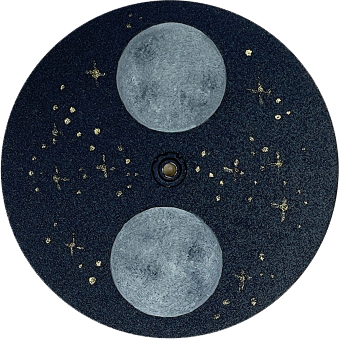
The different moon phases (four in total, each lasting approximately one week) consist of New Moon, Waxing Moon, Full Moon, and Waning Moon.
Moon Phase Display Adjustment
Planning daily life according to the lunar calendar is normal for some people. They plan their lives according to the current phase of the moon and pursue various approaches to this way of life. For some, this sounds like cosmic hocus-pocus, for others it’s a smart way of living.
The moon influences many things on Earth that we are probably unaware of. One example is the tides, the difference in ocean height of up to 20 meters between high and low tide. Due to the moon’s magnetic attraction to Earth’s water, combined with centrifugal force, a so-called “tidal bulge” forms on both the side of the Earth facing the moon and the side facing away from it. Figuratively speaking, the Earth rotates beneath the two intervening tide troughs within a single day. Thus, the moon’s gravitational pull and the centrifugal force in the Earth-Moon system interact to create this effect. The entire system also rotates around a common center of gravity located within the Earth.
The moon also changes its appearance, which are the different lunar phases we know. These phases arise from the changing perspective of the moon’s position relative to Earth as it orbits the planet. The moon always presents the same face to Earth, meaning it rotates once on its own axis as it orbits the planet. One orbit takes 29 days, 12 hours, 44 minutes, and 2.8 seconds. This phase is also called a “lunation.” The different lunar phases (four distinct phases, each lasting approximately one week) consist of new moon, waxing moon, full moon, and waning moon. Furthermore, there are special events such as lunar and solar eclipses, which are much-watched natural phenomena. Besides the moon’s weak gravity, which makes objects on the moon about six times lighter than on Earth, it’s also interesting to note that the temperature on the moon can vary between +130 and -160 degrees Celsius.
Calculation of the moon phase display